Choosing an MBA program is one of the highest-stakes financial decisions you will make in your twenties. You aren’t just paying for a degree; you are buying an alumni network, corporate exposure, and your first major placement opportunity.
For years, students assumed they had to relocate to Delhi or Pune to secure a high-paying management role. However, as Bareilly quickly transforms into a significant corporate and healthcare hub in Uttar Pradesh, local institutions have improved their offerings. Today, staying close to home no longer means compromising on your career trajectory—if you choose the right campus.
However, separating reality from glossy college brochures is difficult. Between inflated placement claims and hidden fees, finding the true Return on Investment (ROI) requires digging.
The 2026 Reality Check: A higher fee does not automatically guarantee a higher starting salary. Your choice should depend entirely on your end goal: Do you want a rigorous corporate launchpad, a budget-friendly government degree, or a campus with global ties?
We have bypassed the marketing noise to bring you the hard data for the 2026–2027 academic session. Whether you are targeting top-tier recruiters at KCMT, looking for the modern infrastructure of Invertis, or seeking the unmatched affordability of MJPRU, this guide breaks down everything you need to know.
| Parameters | Particulars/Statistics |
|---|---|
| Number of MBA Colleges | 22 |
| Annual Fees | INR 1-2 lakh: 12 colleges, INR 2-3.5 lakh: 3 colleges |
| Top MBA Institutes in Bareilly | Khandelwal College of Management Science and Technology (KCMT), Shri Ram Murti Smarak College of Engineering and Technology, Invertis Institute of Management Studies, LBSIM, Mahatma Jyotiba Phule Rohilkhand University, Rajshree Institute of Management and Technology, Future Institute of Engineering and Technology, etc. |
| Top Specialisations | Finance, Human Resources, Sales and Marketing, International Business, etc. |
| Accepted Entrance Exams | CAT, CMAT, MAT, XAT, CUET PG, etc. |
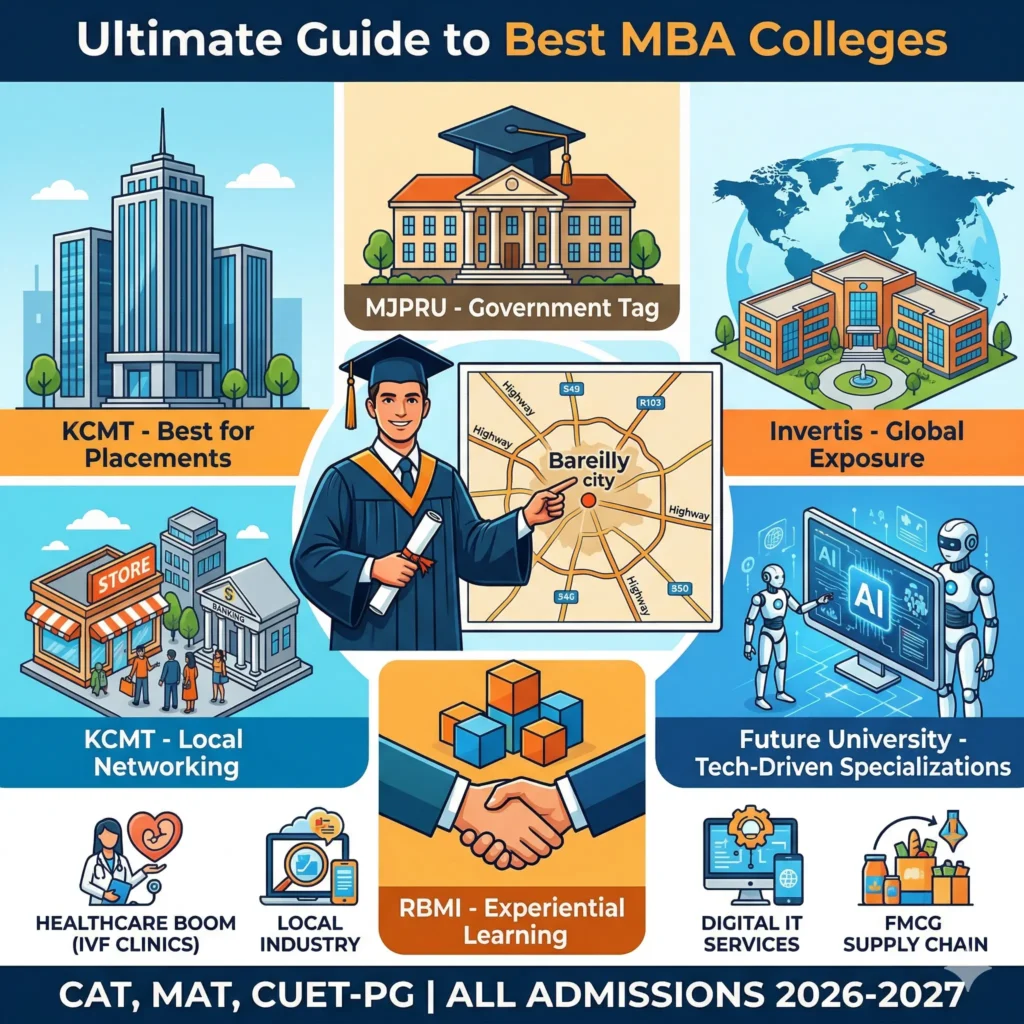
Table of Contents
Why Choose Bareilly for Your MBA?
The Heavy Hitters: Top MBA Colleges in Bareilly (2026 Rankings)
Decoding the Admission Process for 2026
Fee Structures & Financial Planning
The Reality Check: Placements and ROI
In-Demand Specializations for the 2026 Market
Conclusion
Why Choose Bareilly for Your MBA?
1.Cost-Effectiveness
Let’s talk numbers, because an MBA is fundamentally a business decision. If you look at the Delhi NCR belt, pursuing a management degree is an incredibly expensive endeavor. According to a 2026 fee analysis by Promilo, top-tier private institutions in the NCR region charge anywhere from ₹12.9 Lakhs at LBSIM to over ₹21.3 Lakhs at MDI Gurgaon (Source: Promilo, March 2026). Even the more moderately priced private colleges in Delhi hover around ₹8 to ₹11 Lakhs for a two-year program (Source: Promilo, March 2026).
Now, bring your focus to Bareilly. You do not have to mortgage your future to get a recognized degree here. Data compiled by MetroSkope in March 2026 shows that the top AICTE-approved private colleges in Bareilly cap their total two-year fees at a fraction of metro costs. KCMT—Khandelwal College of Management Science & Technology—charges just ₹1.44 Lakhs in total, while premium private options like SRMSCET sit at about ₹3.07 Lakhs (Source: MetroSkope, March 2026). If you secure a seat at the government-backed MJPRU, your total fees can range from as low as ₹22,500 up to ₹1 Lakh for the entire program, depending on your specific MBA track (Source: MetroSkope, March 2026).
Then there is the daily survival math. The cost of living index database CostOfLivingIndia.com reported in 2026 that renting a standard 1BHK in Delhi NCR easily costs around ₹22,000 per month, with metropolitan indexes driving up daily costs for food and transport. In contrast, smaller Tier-2 cities in Uttar Pradesh like Bareilly or Lucknow offer double-sharing paying guest (PG) accommodations for as low as ₹5,500 to ₹6,500 per month, with standard veg thalis costing roughly ₹80 compared to Delhi’s ₹120 (Source: CostOfLivingIndia.com, 2026). In simple terms, a Bareilly student graduates with high-quality credentials but without the crushing EMI burden that forces NCR graduates to accept the first job they are offered just to pay the bills.
2. Emerging Economic Hub
Bareilly does not make the flashy national headlines of Gurugram, but if you look at the groundwork, the city is undergoing a massive infrastructural and corporate shift. Under the Bareilly Smart City Mission, managed by Bareilly Smart City Limited (a public limited company actively executing municipal projects), the local government has been rolling out major urban developments, integrating rapid modernization, tech-friendly commercial zones, and physical infrastructure overhauls (Source: Square Yards & Tracxn, March 2026). This isn’t just cosmetic; it is laying a solid foundation for a localized corporate boom.
Because of this modernization, the Rohilkhand region is rapidly becoming a high-growth hotspot for B2B commerce, educational technology—such as specialized smart school ERP systems being increasingly adopted by the massive network of local private international schools—and regional performance marketing. But the true powerhouse here is the Fast-Moving Consumer Goods (FMCG) and agribusiness sector. Bareilly serves as a central artery for massive local brands trading in daily-use goods like tea, spices, mustard oils, and pickles. Consequently, the demand for digital content creators, supply chain managers, and B2B lead generation specialists is skyrocketing locally. When major FMCG brands or educational tech firms look to scale up, they actively recruit local management talent who understand the exact pulse of the Uttar Pradesh market.
The Heavy Hitters: Top MBA Colleges in Bareilly (2026 Rankings)
1. Khandelwal College of Management Science and Technology (KCMT)
Best for: Local business networking, balanced campus life, and a mid-range budget.
If you want the infrastructure of a private institute but find the fees at Invertis too steep, KCMT is the most logical middle ground. Affiliated with MJPRU and approved by AICTE, KCMT bridges the gap beautifully between premium private universities and standard government colleges.
Estimated Total Fees (2 Yrs): ₹1.33 Lakhs – ₹1.4 Lakhs
Average Package: ₹3.0 LPA
Highest Package (2025): ₹6.5 LPA
Placement Edge: KCMT’s strength lies in its deep roots within the local Bareilly market. It has excellent tie-ups with regional retail chains, real estate developers, local banking branches, and FMCG distributors.
Top Recruiters: Mostly mid-cap companies, local branches of HDFC, Bajaj Finserv, Reliance Retail, and regional digital agencies
2. Mahatma Jyotiba Phule Rohilkhand University (MJPRU)
Best for: Extreme affordability and government university brand value.
MJPRU’s Department of Business Administration is the oldest in the region. While it does not offer the glossy infrastructure or the aggressive spoon-fed placement drives of private colleges, a state university degree carries undeniable weight, particularly if you plan to apply for public sector undertakings (PSUs) or government roles later.
Estimated Total Fees (2 Yrs): 85000-170000 (Varies heavily based on quota and self-financed vs. regular seats)
Average Package: ₹2.5 LPA – ₹3.0 LPA
Placement Edge: You are paying a fraction of the cost of a private MBA. Even with a lower starting salary, you graduate essentially debt-free. Students here are highly self-driven, often securing off-campus placements in local industries.
3. Invertis University
Best for: Premium infrastructure, global exposure, and diverse specializations.
If you are looking for the “classic” private MBA campus experience complete with massive industry seminars, international guest lectures, and a vibrant student life, Invertis is the premier choice. Their dedicated Corporate Resource Centre (CRC) aggressively brings major multinational brands to the city.
Estimated Total Fees (2 Yrs): ₹2.8 Lakhs – ₹3.0 Lakhs
Average Package: ₹3.70 LPA
Highest Package (2025): ₹9.0 LPA
Placement Edge: Invertis excels in placing students in modern corporate roles—specifically digital marketing, HR consulting, and IT services. They also offer highly relevant new-age electives that government universities often lack.
Top Recruiters: Deloitte, Amazon, HCL, Axis Bank, and major FMCG brands like Bikanervala.
4. Shri Ram Murti Smarak (SRMS) College of Engineering & Technology
Best for: Maximum Return on Investment (ROI) and rigorous corporate discipline.
SRMS operates more like a traditional corporate training ground than a relaxed university campus. It is widely known in the region for its strict academic discipline—a trait that sometimes frustrates students but is highly prized by local and national recruiters.
Estimated Total Fees (2 Yrs): ₹1.5 Lakhs
Average Package: ₹4.11 LPA
Highest Package (2025): ₹7.02 LPA
Placement Edge: SRMS dominates regional placements in banking, finance, and pharmaceuticals. If your goal is to secure a stable corporate role immediately upon graduation, SRMS has the most consistent track record.
Top Recruiters: HDFC Bank, ICICI Bank, TCS, Tech Mahindra, and Sun Pharma.
5. Future University (Formerly Future Group of Institutions / FIMS)
Best for: Tech-integrated management, new-age specializations, and AI-driven curriculum.
Recently upgraded to a full State Private University, Future University is the most aggressively growing campus on the Bareilly-Lucknow highway. It is branding itself as a highly modern, “AI-enabled” campus, setting itself apart from older, more traditional institutions by partnering directly with corporate giants for its curriculum.
Estimated Total Fees (2 Yrs): ₹2.0 Lakhs – ₹2.5 Lakhs
Average Package: ₹3.5 LPA – ₹4.5 LPA
Highest Package (Overall): ₹18 LPA (Domestic Management/Tech roles)
Placement Edge: While SRMS dominates traditional banking and KCMT rules local retail, Future University excels in the intersection of management and technology. They offer unique, industry-tied MBA programs (like Digital Marketing powered by Imarticus Learning, and FinTech powered by NISM) that make graduates highly attractive to modern tech consultancies and e-commerce brands.
Top Recruiters: Tech Mahindra, HCL, Wipro, Cognizant, and Policy Bazaar.
6. Rakshpal Bahadur Management Institute (RBMI)
Best for: Experiential learning, practical skills, and mid-tier corporate roles.
RBMI is a veteran player in Bareilly’s education ecosystem. It has built its reputation on a “learning by doing” philosophy, focusing heavily on industry-aligned workshops and live projects rather than purely theoretical classroom lectures.
Estimated Total Fees (2 Yrs): ₹1.8 Lakhs
Average Package: ₹3.50 LPA
Placement Edge: RBMI boasts a very high placement percentage (often crossing 90%). While it may not hit the extreme high-salary outliers of SRMS or Invertis, it provides incredibly consistent, reliable placements in sales, operations, and IT-enabled services.
Top Recruiters: Wipro, Jaro Education, Genpact, and local real estate developers.
Decoding the Admission Process for 2026
Standard Entrance Exams
Admission policies vary at every college, and Bareilly’s institutions are no different. But the consistent reality is that entrance exams act as your primary bargaining chip. If you are targeting premium private campuses like Invertis University, they offer a wide safety net. According to their 2026 admission guidelines, they accept a broad spectrum of national-level scores including CAT, MAT, XAT, ATMA, and CUET-PG (Source: Shiksha, March 2026). For most local students, the MAT (Management Aptitude Test) is the go-to choice. It does not carry the intimidating, cut-throat pressure of the CAT, and since it is conducted multiple times a year, it gives students ample opportunities to secure a qualifying score without wasting an academic cycle.
The CUET-PG Shift
It does not make national headlines, but the admission pipeline in Uttar Pradesh has quietly undergone a massive structural shift. Previously, universities ran their own scattered, independent entrance exams. Today, the state has firmly consolidated its process. If you want a state-quota seat at Mahatma Jyotiba Phule Rohilkhand University (MJPRU) or any of the top-tier private colleges affiliated with Dr. A.P.J. Abdul Kalam Technical University (AKTU) like SRMSCET, you have to go through the CUET-PG (Source: UPTAC Admissions Information Brochure, 2026). The Uttar Pradesh Technical Admission Counselling (UPTAC) explicitly relies on CUET-PG scores for its centralized MBA seat allotments across the state. This means the process is highly transparent, and you must compete on a standardized national testing level.
Direct Admissions
Of course, exams are just one route. There is a very practical, parallel pathway through direct admissions for those who wish to bypass the lengthy UPTAC counselling. Under the regulatory framework set by AKTU, private affiliated institutions are legally permitted to fill 15% of their total approved intake strictly under the Management/NRI Quota at the institute level (Source: AKTU Chapter-5 Eligibility Criteria, 2026). Furthermore, if a college has vacant seats after the official UPTAC counselling rounds conclude, they can fill those seats directly based on a student’s graduation merit. The baseline requirement here is universally a minimum of 50% aggregate in your bachelor’s degree (45% for SC/ST candidates) (Source: AKTU Admission Guidelines, 2026). It is a straightforward route, though it usually requires you to step outside the standard state scholarship pools.
The Interview Stage
Test scores get you in the building, but the Group Discussion (GD) and Personal Interview (PI) dictate whether you actually get the seat. The intensity of these interviews varies at every college, but the consistent feedback from recent students paints a very specific picture. Bareilly’s institutions are not trying to grill you on complex, international financial derivatives. Most interview panels combine academic staff with visiting corporate faculty, which means they are looking for practical, communicative individuals. They want to see baseline confidence, a clear rationale for pursuing an MBA, and an awareness of the local business landscape—such as Rohilkhand’s booming FMCG and manufacturing sectors. As long as your answers are genuine and do not feel completely disconnected from practical realities, clearing this final stage is highly manageable.
In-Demand Specializations for the 2026 Market
The Classics: Marketing, Finance, and Human Resources
Let’s talk about the traditional triad. These have been around forever, but the way recruiters hire for them has completely changed. You cannot just graduate with a generic degree in one of these fields and expect a job to fall into your lap.
Marketing: Forget the old days of simply brainstorming billboard campaigns. Today, FMCG giants and massive retail distributors are dominating the UP job market. A marketing MBA is only valuable if it is tied to tangible sales and digital strategy. The demand is intense for Area Sales Managers and Brand Managers who understand both traditional on-the-ground distribution networks and modern performance marketing. If you can’t measure your Return on Investment (ROI) on an ad spend, modern companies aren’t interested.
Finance (BFSI): This remains the most rigorous—and often highest-paying—classic specialization. The Banking, Financial Services, and Insurance (BFSI) sector, led by recruiters like HDFC, ICICI, and regional fintech startups, is heavily hiring. They aren’t just looking for basic accountants; they need risk analysts, corporate banking associates, and wealth managers. Starting packages for specialized finance roles consistently average between ₹6–8 LPA for freshers, scaling significantly higher for those at top-tier institutes.
Human Resources (HR): HR has drastically shifted from “payroll and office parties” to intense talent acquisition and organizational psychology. With the massive influx of specialized healthcare (like IVF clinics and multi-specialty hospitals) and tech firms in Bareilly and UP West, businesses are desperate for HR graduates who understand technical recruitment, labor compliance, and employee retention strategies.
The Up-and-Comers: Information Technology, Supply Chain Management, and Business Analytics
If you want to future-proof your career, negotiate higher starting salaries, and make yourself indispensable, this is where the market is aggressively shifting in 2026.
Supply Chain Management (SCM) & Operations: Let’s look at the facts. With the explosion of quick-commerce and major FMCG/e-commerce warehouses setting up operations along the UP highway corridors, SCM is experiencing a massive talent shortage. Roles like Procurement Manager, Warehouse Operations Head, and Logistics Analyst are seeing starting salaries jump to ₹8–15 LPA. This is no longer a back-office tracking job; managing an efficient, tech-driven supply chain is now the absolute backbone of the retail industry.
Information Technology (IT) & Business Analytics: Data is the new currency. The 2026 hiring trends indicate that recruiters no longer just want a manager; they want a problem-solver who understands data models and AI tools. Roles in business analytics, data strategy, and tech consulting command premium packages, often ranging from ₹14–22 LPA depending on the institute’s pedigree and the candidate’s technical fluency.
The Dual-Specialization Edge: Here is the real insider secret. A pure IT or pure Marketing degree is good, but a dual-specialization makes you lethal in the job market. Think about pairing Marketing + Business Analytics (so you can track the exact data of consumer behavior) or Operations + IT (to manage automated, AI-driven supply chains). Colleges that offer these hybrid specializations give you a massive, undeniable edge over candidates holding a standard, single-track degree. It proves to employers that you understand both the business strategy and the technology required to execute it.
Conclusion: Which Bareilly MBA is Right for You?
Choosing the “best” MBA college in Bareilly isn’t about finding the highest-ranked name on a list; it’s about matching your career goals with the right institutional DNA. As we have seen, the 2026 landscape in Bareilly offers a diverse range of paths:
- For the Corporate Careerist: If you want a high-pressure, high-reward environment with the most consistent placement track record, K.C.M.T & SRMS remain the gold standard.
- For the Modern Innovator: If you are looking for global exposure, premium infrastructure, and new-age specializations, Invertis University, K.C.M.T and Future University are leading the digital charge.
- For the Budget-Conscious Professional: If you want a respected government degree and the freedom to graduate debt-free, MJPRU is your best strategic move.
- For the Local Networker: If your goal is to dominate the regional market in Western UP, KCMT and RBMI provide the practical, localized networking you need.
Checklist for Prospective Students
- Aligning budget with expected placement packages (Calculating ROI)
The biggest trap students fall into is looking solely at the “Highest Package” advertised. That number is usually an outlier—one student securing a highly specific role. To understand the actual financial value of a degree, you must look at the Median CTC and calculate your true Return on Investment (ROI).
In the Indian MBA market, a healthy short-term ROI means you should be able to recover your total investment (tuition plus hostel fees) within 12 to 18 months of working.
The ROI Formula: Total Investment ÷ Annual Average Package.
The Reality Check: If an institute charges ₹8 Lakhs for a two-year program and the median placement is ₹4 LPA, your ROI ratio is 2.0x (Poor). It will take you over two and a half years just to break even on your education cost.
The Bareilly Context: This is why institutions like SRMS CET score highly on logical ROI metrics. With a total fee of approximately ₹1.5 Lakhs and an average package hovering around ₹4.11 LPA, the ROI ratio is roughly 0.36x. You recover your total academic investment in less than six months. MJPRU, with fees under ₹80,000 and average salaries around ₹2.5 LPA, offers an equally exceptional, risk-free financial recovery rate.
- Verifying campus culture and alumni networks
Brochures will list global brands like Deloitte, TCS, and HDFC as recruiters, but they rarely tell you what roles those companies are hiring for or how many students were actually placed.
The Placement Report Trap: Look for institutions that follow the Indian Placement Reporting Standards (IPRS) or have their placement data audited by independent bodies like CRISIL. If a college refuses to disclose the percentage of the batch placed or hides their median salary, treat it as a massive red flag.
The LinkedIn Test: Do not rely on the college website to verify the alumni network. Go to LinkedIn, search for the college, and click on the “Alumni” tab. Filter by graduates from 2023 to 2025. Look at where they are actually working. If a brochure advertises “100% corporate placements,” but a large chunk of recent alumni on LinkedIn are working at unknown local agencies or are “Open to Work,” you have found the gap between marketing and reality.
- Matching specializations with career goals (Corporate vs. Government)
Your specialization and the type of institution you choose must strictly align with your endgame. The 2026 hiring market makes a harsh distinction between corporate skillsets and public sector requirements.
The Corporate Track: If your goal is to immediately enter the private sector—especially in Bareilly’s booming IT services, healthcare administration, or FMCG supply chains—you need a private institution with aggressive industry tie-ups. Colleges like Invertis University or Future University are built for this. They frequently update their curriculum with industry-certified modules (like Business Analytics and FinTech) that private recruiters demand.
The Government Track: If you are using your MBA as a stepping stone for Public Sector Undertakings (PSUs), state banking exams (IBPS), or civil services, do not spend ₹3 Lakhs on a private corporate MBA. You need a recognized degree with minimal financial burden so you can afford to spend time preparing for competitive exams. For this route, a state-run institution like MJPRU is the undisputed best choice. It provides the necessary UGC-recognized postgraduate qualification while keeping you virtually debt-free.
Final Takeaway for 2026 Aspirants
The industrial and healthcare boom in Bareilly—from the expansion of specialized IVF clinics to the rise of regional IT hubs—means you no longer have to migrate to a metro city to find a “Tier-1” career. By staying local, you can leverage the lower cost of living to maximize your true Return on Investment.
Your Next Steps:
Check the Dates: Ensure you are registered for the CUET-PG or the specific university entrance exams (like IUCET).
Visit the Campus: Data is vital, but the “vibe” of a campus matters. Schedule a visit to your top two choices this month.
Talk to Alumni: Reach out to recent graduates on LinkedIn to get the unfiltered truth about current placement cycles. The industrial and healthcare boom in Bareilly—from the expansion of specialized IVF clinics to the rise of regional IT hubs—means you no longer have to migrate to a metro city to find a “Tier-1” career. By staying local, you can leverage the lower cost of living to maximize your true Return on Investment.
FAQs
Q1: Which MBA college in Bareilly has the highest placement?
Khandelwal College of Management Science and Technology, Invertis University and SRMS CET consistently record the highest packages in the city. For the 2025–2026 cycle, Invertis recorded a peak package of ₹9 LPA (with some off-campus outliers hitting higher), while SRMS recorded a high of ₹7.02 LPA. However, for consistent average packages, KCMT remains the leader.
Q2: Is CUET-PG mandatory for MBA admission in Bareilly for 2026?
It depends on the college. CUET-PG is mandatory for admission to the government seats at MJP Rohilkhand University (MJPRU). Most private colleges like K.C.M.T, SRMS, Invertis, and Future University accept CUET-PG scores but also offer admission based on CAT, MAT, XAT, or their own internal entrance tests.
Q3: Can I get direct MBA admission in Bareilly without an entrance exam?
Yes. Many private institutions, including K.C.M.T, Future University, Invertis, and RBMI, have a provision for Direct Admission based on your graduation percentage (merit-based) or through a management quota. You will typically still need to clear a Personal Interview (PI) or Group Discussion (GD) round.
Q4: What is the lowest fee for an MBA in Bareilly?
The most affordable MBA is offered by MJP Rohilkhand University (MJPRU), where the total two-year tuition fee can range from ₹16,000 to ₹80,000 depending on whether you secure a regular or self-financed seat. Among private colleges, KCMT and RBMI offer competitive fees starting around ₹1.3 Lakhs.
Q5: What are the key dates for Bareilly MBA admissions 2026?
CUET-PG Registration: Usually opens in January 2026.CUET-PG Exams: Conducted in March 2026.Private University Applications: Most (like Future and Invertis) are open now and accept applications until July 2026.UPTAC Counselling: Expected to begin in June 2026.
Q6: Which MBA specializations are most in demand in the Bareilly market?
Given Bareilly’s growth as a regional hub, the three highest-demand specializations for 2026 are: Healthcare & Hospital Management (due to the surge in multi-specialty and IVF clinics).Digital Marketing & E-Commerce (for the rising IT consultancy sector).Supply Chain & Logistics (driven by the city’s FMCG and agricultural trade).